Enterprise AI essay
The Enterprise Cognitive Layer
Why AI Won't Replace Enterprise Software — It Will Connect It
Why AI Won't Replace Enterprise Software — It Will Connect It
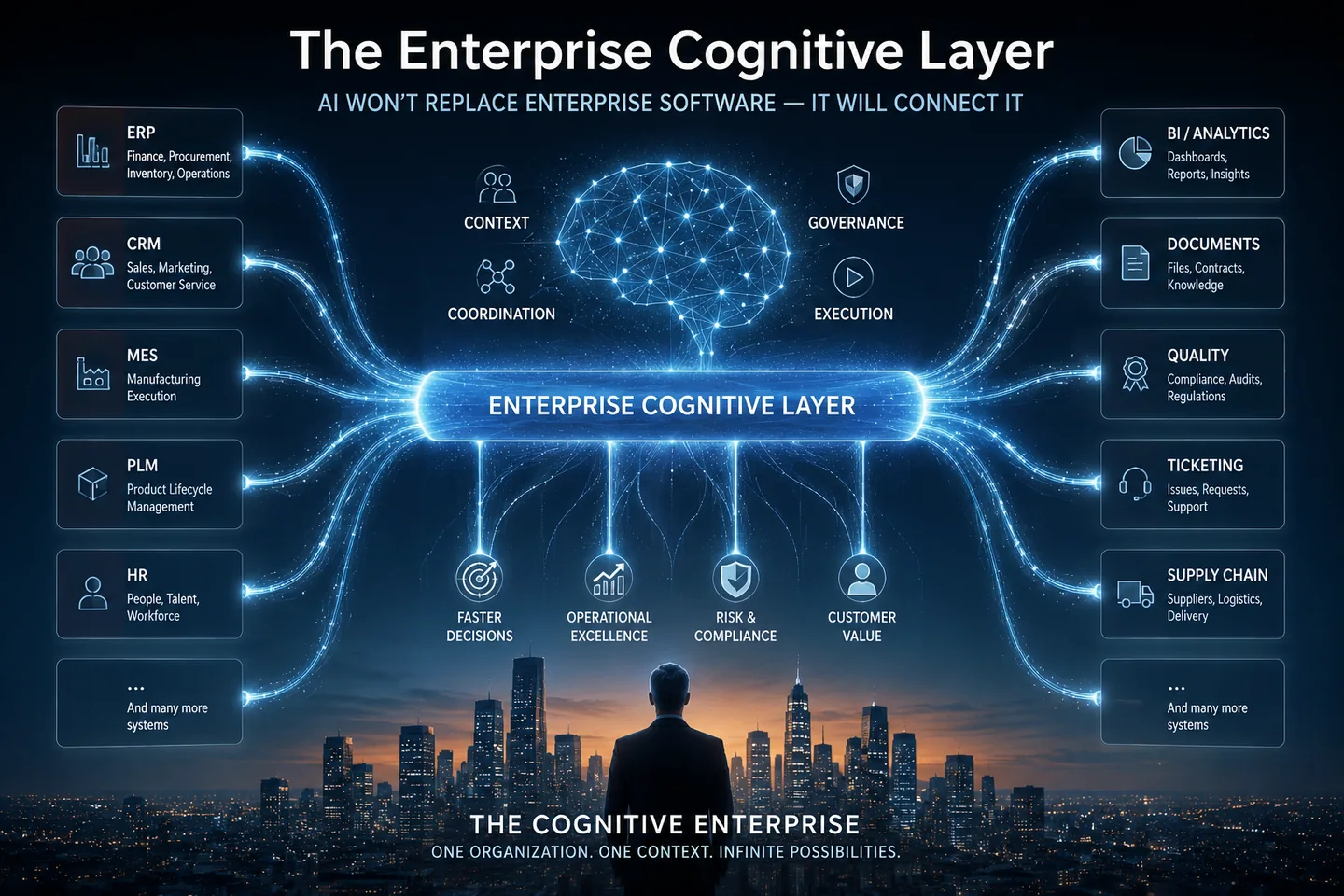
The enterprise already has organs. It already has a brain. What it has never had is a nervous system.
Everyone keeps asking which enterprise applications AI will replace.
That's the wrong question.
AI is unlikely to replace enterprise software. It will connect it.
The replacement story is seductive because it is simple. If a model can write the email, draft the contract, reconcile the invoice and summarise the customer call, then the software that used to mediate all of that becomes ceremony. The CRM collapses into a chat window. The ERP collapses into a prompt. Twenty years of enterprise IT evaporates into a text box, and a generation of software companies discovers it was selling interfaces to a problem that no longer needs one.
It is a good story. It is also, I think, wrong — and wrong in a way that costs money, because it sends companies hunting for the wrong thing. They go looking for the application AI will kill, when they should be looking for the layer AI makes possible.
Here is the uncomfortable version of what is actually happening:
Most companies believe they are buying AI.
In reality, they are buying isolated intelligence.
And intelligence without coordination is just a more expensive form of fragmentation.
Enterprise software was never mainly an interface problem. It is a system-of-record problem, a compliance problem, a transactional-integrity problem, and — this is the part consultants are too polite to say out loud — an organisational-politics problem. An ERP is not hard to replace because its screens are hard to rebuild. It is hard to replace because it encodes two decades of accumulated decisions about how this specific company recognises revenue, values inventory, closes a quarter and survives an audit. Nobody wrote those rules down. They were argued into existence, one exception at a time, by people who have since retired. A chatbot is not going to re-derive them.
So the question is not whether these systems survive. They will. The question is whether they will ever behave as one.
Walk into a mid-sized manufacturer and start counting. ERP for finance and materials. CRM for pipeline. MES on the shop floor. PLM for product data. A separate HR suite that nobody likes. A ticketing platform. A BI stack. Document management. Quality. A procurement portal. Then the shadow estate: three or four tools a department bought on a company card and never mentioned to IT, which are now load-bearing.
The count is rarely under fifty. Past a few thousand employees it routinely passes two hundred.
Every one of those systems was bought for a defensible reason. Every one solves a real problem well. And every one was designed, quite deliberately, to own its domain — to be the authoritative place where a particular kind of truth lives. That was the entire value proposition. It is also the entire problem.
The result is an organisation that is excellent in every part and incoherent as a whole. A body with superb organs and no way to coordinate them.
The symptoms are so familiar that most executives have stopped registering them as symptoms:
That last one deserves more attention than it gets. In most enterprises the integration layer is not middleware. It is middle management. We have built an entire professional class whose real job — whatever the title says — is to be the API between two systems that were never introduced. They are expensive, they don't scale, they go on holiday, and when they leave they take the schema with them.
And the arithmetic is against us. Complexity compounds faster than the organisation grows. Each new system added to the estate does not add one connection; it adds a connection to everything already there. Headcount grows linearly. Coordination cost grows combinatorially. This is the real reason large companies feel slower than small ones despite having more of everything, and the reason the marginal return on the next software purchase keeps falling even as the software itself keeps getting better.
We did not build companies. We built federations of applications and hoped the people would hold them together.
For most of the history of computing, the scarce input was reasoning. Software executed rules; it could not interpret. Anything requiring judgement had to be escalated to a human, which is why every workflow diagram ever drawn ends in a box marked "review."
That constraint is gone, and it went faster than almost anyone in this industry planned for.
Intelligence is now a commodity input: available on demand, from competing suppliers, at a marginal cost that keeps falling, with capability gaps that narrow every release cycle. Any company can rent a model that reads a contract, interprets an exception, drafts a response, reasons about a chart. The model is no longer the differentiator, for the simple reason that your competitor has the same one — quite possibly the identical one, billed to the same cloud.
When an input becomes abundant, value migrates to whatever remains scarce beside it. Bandwidth got cheap and value moved to platforms. Compute got cheap and value moved to data. Intelligence has got cheap, and value is moving to four things no model provides on its own.
This is why so many enterprise AI programmes die quietly between the pilot and the rollout. The pilot proves the model can reason — that was never in doubt. The rollout fails because nothing in the organisation is arranged to give that reasoning context, coordination, governance or hands. The model was the easy part. It was always going to be the easy part.
Intelligence scales.
Context compounds.
And this is where the anatomy finally makes sense. The enterprise has organs — ERP, CRM, MES, HR, each doing its work competently and in isolation. As of about two years ago, it also has a brain: reasoning is now something you can buy by the token.
The brain already exists. What is missing is the nervous system.
What is missing is not another application. It is a layer — and layers are harder to see than products, which is why this one has taken so long to name.
An Enterprise Cognitive Layer is an orchestration layer that understands enterprise context, reasons across disconnected systems, coordinates AI agents, and turns software into a single adaptive intelligence.
It sits above the application estate and below the intent of the business. It does not hold the transaction — the ERP does. It does not own the customer record — the CRM does. What it owns is the only thing no existing system owns: an understanding of how everything relates, and the authority to act on that understanding.
Four capabilities define it.
Context. The layer maintains a semantic model of the enterprise — which entities exist, how they map across systems, what the internal vocabulary actually means, what happened before and why. When someone says "the Rossi account is at risk," the layer knows which of the eleven Rossi records is meant, which contract governs it, which tickets are open against it, and what happened the last time this pattern appeared in a different region. This is the Enterprise Memory Layer, and it is becoming the most defensible asset a company can hold, precisely because it cannot be bought, licensed or copied. It can only be accumulated.
Reasoning across boundaries. The layer's native unit of work spans systems. "Why did margin fall in the northern region last quarter?" is not an ERP question or a BI question. Its answer is distributed across pricing data, production yield, logistics cost and three sales conversations that were never written down anywhere structured. The cognitive layer is the first place in the stack where that question can even be asked.
Agent coordination. One agent is a demo. A fleet of agents is a distributed systems problem: sequencing, contention, retries, partial failure, escalation, the question of what happens when two agents reach opposite conclusions about the same customer at the same moment. The Cognitive Runtime is the engine that handles it — planning work, dispatching it, recovering from failure, and knowing when to stop and ask a human. This is the part organisations consistently underestimate, and it is where most AI initiatives actually die, long after the press release.
Governance and supervision. Every action attributable. Every decision carrying its reasoning, its inputs and its authorisation. Autonomy granted by policy rather than assumed by default. In a European enterprise this is not a refinement; under the AI Act it is the precondition of deployment. The systems that win here will be the ones where governance was designed in from the first line, not bolted on after the first incident — and there will be a first incident.
Put those four together and something appears that has not existed before: an enterprise that can be addressed as a whole.
Software is no longer where intelligence lives.
It is where intelligence executes.
It is worth being exact about what this displaces, because the exaggerated version of this argument is how credibility gets lost.
ERP keeps doing ERP. CRM keeps doing CRM. MES keeps doing MES. Systems of record remain systems of record, and they should: they are hardened, audited, regulated and — an underrated virtue — correct. Reimplementing revenue recognition inside a language model is not innovation. It is a control failure with a launch event.
What changes is position, not existence. These systems stop being destinations and become capabilities. Nobody logs into infrastructure. Nobody thinks about the database when they open an app. In exactly the same way, the enterprise application becomes something people no longer navigate and something the cognitive layer simply calls.
Enterprise software is becoming what electricity became a century ago:
absolutely essential,
increasingly invisible.
The layer understands, connects, decides, coordinates, supervises. It does not replace. It amplifies.
Which is, incidentally, why the incumbents are less threatened than the replacement narrative claims — and considerably less safe than they believe. Their data and workflows are genuinely hard to dislodge; nobody is ripping out a working ERP for fashion. But the layer above them is unclaimed, and whoever occupies it owns the relationship with the business. The application becomes a supplier to the layer. Suppliers are substitutable in a way platforms are not, and every incumbent knows it, which is why the next five years of enterprise software strategy will be a quiet war over who gets to be the layer.
The deepest change here is not architectural. It is linguistic.
Today we think in software. We say: open the CRM, run the report, export it, cross-check it against the ERP, build the list, write the emails. The sequence of tools is the work. Knowing the sequence is what makes somebody senior — which should tell you something uncomfortable about how we have been defining seniority.
Tomorrow we will think in capabilities. We will say:
Find the customers most likely to churn and prepare personalised recovery plans.
Nobody specifies which systems to use. The agent decides — pulling usage data from one place, contract terms from another, support history from a third, sales context from a fourth, because that is what the request actually requires. The systems become implementation detail, which is the highest compliment software can be paid.
This is a bigger shift than it looks, because it inverts who performs the translation. For sixty years, humans translated business intent into machine operations. That translation was the job. It is what the ERP consultant, the business analyst and the departmental power user were all being paid for, whatever their business cards said. The cognitive layer moves that translation to the machine.
The consequences run right through the organisation. Software selection stops being about features and starts being about interoperability and semantic clarity — a system that cannot expose what it knows becomes a liability no matter how good its interface is. Training shifts from tool proficiency toward specifying intent and verifying results, which are genuinely different skills and are not taught anywhere. And the competitive question changes from "do we have the right applications?" to something far more searching: can our applications be reasoned over at all?
Models answer questions.
Organizations execute decisions.
Here is the prediction, offered with the appropriate humility about timing:
Within ten years, nobody will know
which ERP,
which CRM,
which workflow
performed a task.
They will simply know that the company acted.
That sounds like a loss of visibility. It is the opposite. Nobody knows which server answered their web request either, and nobody has wanted to know since about 2010. Abstraction is not ignorance. It is what progress looks like from the outside.
It is worth stepping back, because there is a pattern here and we have lived through two iterations of it already.
The internet connected computers. Before it, machines were individually capable and collectively isolated. Afterwards the network was the computer, and value accrued to whoever organised the connections rather than whoever manufactured the machines. Very few people saw that coming, and most of those who did were early by a decade.
The cloud connected infrastructure. Servers stopped being assets a company owned and became a capability it drew on. The winners were not the ones with the best data centres. They were the ones who made data centres stop being a subject of conversation.
The Internet connected computers.
The Cloud connected infrastructure.
APIs connected systems.
AI connects decisions.
The Enterprise Cognitive Layer connects organizations.
That is the fourth movement, and it operates a level above the previous three. APIs let systems exchange data. They never let systems agree on what the data meant. Integration told the CRM what the ERP contained; it never told either of them what it implied.
APIs exchange data.
Cognitive layers exchange meaning.
A cognitive enterprise is one where a decision made anywhere is informed by everything the organisation knows, and propagates to every system it should touch, without a human carrying it between them. It is not a company with more automation. It is a company with fewer disconnects — where the distance between knowing something and acting on it collapses toward zero.
I would expect this to unfold the way the previous transitions did: more slowly than the enthusiasts promise, further than the sceptics allow, and with returns distributed far more unevenly than anyone currently assumes. The gap will not be between companies that adopted AI and companies that didn't; everyone will adopt AI, mostly the same AI, mostly within the same eighteen months. The gap will be between companies whose systems can be reasoned over and companies whose systems cannot.
And that gap widens on its own, because context accumulates. The organisation that starts building institutional memory this year will not be one year ahead in three years. It will be three years of compounding ahead, which is a different kind of lead entirely — the kind that cannot be closed by spending more.
The next generation of enterprise software will not be defined by better applications. It will be defined by better connections.
That is an uncomfortable conclusion for an industry organised almost entirely around applications — around seats, modules, features, per-user pricing and the annual renewal conversation. But the binding constraint on enterprise performance has moved. It is no longer the quality of any individual system. It is the coherence of the whole.
Intelligence is no longer the competitive advantage.
Coordination is.
Every enterprise already owns enough software. What it lacks is a common intelligence.
The companies that win the next decade will not be the ones with the smartest models. Those will be rented, like electricity, by everyone, from a handful of suppliers, at broadly similar prices. Model access is going to be table stakes faster than most boards expect, and the strategic conversation that follows will be far more interesting than the one we are having now.
There is one more thing worth saying, and it is the part I am most confident about.
Every technological revolution eventually becomes invisible.
Electricity did.
The Internet did.
Cloud computing did.
Artificial intelligence will follow the same path.
Nobody will buy AI.
Companies will buy better decisions.
And those decisions will emerge from something we are only beginning to recognise:
the Enterprise Cognitive Layer.
Five terms used in this essay, offered as a shared vocabulary rather than a product description. If they prove useful, they should belong to the industry rather than to any company — including mine.